
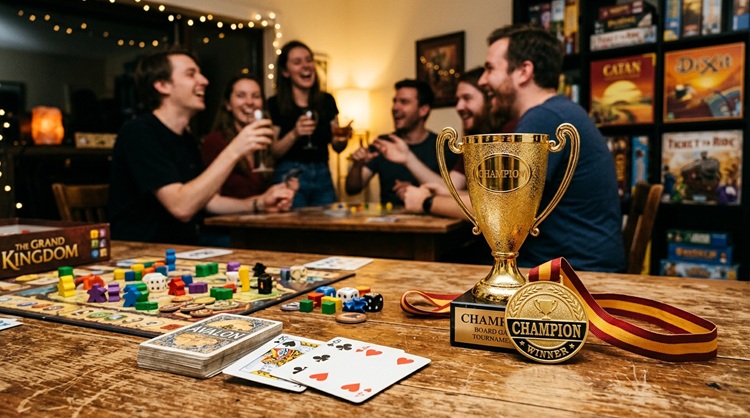

The format of the tournament you decide to organize will determine if the event will run smoothly or get stuck. If you choose the wrong format, you will need to spend half of the night explaining who is playing next, instead of everyone enjoying the games.
For a group of eight or more people, choose a double-elimination bracket. This way, every player is eliminated after two losses. So, nobody will be just waiting and watching twenty minutes into the competition. For smaller groups from four to six participants, it’s best to run a round-robin tournament. This way, every player plays against each other, the number of games remains high, and the final rankings resolve themselves.
Prepare the bracket in advance, before the players arrive. Don’t try to figure it out on the spot.
Map The Space Like A Venue Manager, Not A Homeowner
Your games room should have two areas that are not up for debate: active play zones and spectator zones. Not suggestions – do this or risk having one of those nights where a fight breaks out because someone leaned over during a crucial dart toss.
For darts, your throwing lane needs to be 2-3 meters deep. Then keep your sightlines from the board to the back wall clear. No chairs, no drink tables, nothing there. The spectator zone should be beside the lane, not behind it, with seating angled toward the board. It’s much more comfortable for watching the match and no one is actually in the play zone.
Same goes for pool. A full size (4.5x9ft) table needs 5 feet of space around the table. In of itself, the play zone is smaller than the darts. But pool players are bigger, and need room for cues. Plan for that before the game starts.
Set Up Your Equipment To Regulation Standard
This is the breaking point for most of the home tournament setups. If you’re expecting people to treat the night as more than just a few throwaways before going out, the equipment needs to back that up.
The bullseye is hung at precisely 1.73 meters from the ground. The oche (that’s the throw line) is 2.37 meters from the face of the board. Take a minute to mark it, firmly, with tape on the floor. And don’t eyeball any of it. Plastic oches that slide on the floor are readily available, just search online.
On materials: paper and plastic boards won’t do. They don’t self-heal with each puncture and so your groupings inevitably get wider and the surface degrades. Sisal is industry standard. Tungsten darts will also give you better results than their brass counterparts as they are slimmer in diameter (and hence less wobbly in the air), heal the board better, and are more durable. Hit up your nearest dart shop rather than Kmart. If you’ve thrown a dart before, the difference in build quality is immediately apparent.
Run A Live Leaderboard Throughout The Night
Grab a whiteboard or chalkboard and put it somewhere everyone can see – ideally the spot people naturally drift to between games. Write out the full bracket at the start of the evening, not just whatever round you’re currently on.
It does two things. First, nobody has to keep asking what the score is. Second, and more importantly, it actually builds tension. There’s something about seeing you’re two wins from the final, or watching your biggest rival drop their second game, that makes the whole night feel like it matters. A scoreboard is what turns “a bunch of people playing games” into a proper tournament.
Get one person on scorekeeper duty and make it their job for the night. You can rotate if needed, but someone has to own it – because the moment results start going unrecorded, you get disputes, and disputes drain the energy out of the room fast.
Keep Eliminated Players Active
Spectator fatigue can really dampen the fun during any elimination tournament. Imagine losing in the first round and having to stick around for an hour watching others play. People get bored and disinterested, checking their phones and often leaving early.
One solution is to introduce a side challenge that goes on simultaneously. Have a whiteboard set up with a “highest three-dart score” where the eliminated can play over the course of the night. Or have a separate low-stakes card game running at a table in the corner. A consolation bracket for the first round losers where they play on for a minor prize keeps almost everyone in the running well into the night.
Also, whoever meets whomever could be pre-set. If you know who the favorites are, scatter them amongst the field so they don’t face each other in the first round. Closer games over more rounds lead to a better atmosphere.
Give The Winner Something To Take Home
It’s not necessary for the prize to be costly. A trophy with a low cost, a certificate printed on a piece of paper, a little gadget from a store with items priced at two dollars or less – the prize itself is more important than its cost. Over 30% of homeowners now rate games rooms as an essential or highly desirable home feature (National Association of Home Builders), which tells you people take these spaces seriously. Match that with an event worth remembering.
A prize makes the final feel like a final. Without one, even a close match can feel like it didn’t quite matter.